If you ask a room of founders what is cross border ecommerce, you usually get answers about Facebook ads targeting London or localized Shopify stores.
For a decade, that definition worked. You could source a product in Shenzhen, spin up a storefront in Austin, and ship to a customer in Berlin without ever touching the inventory. The logistics were invisible. The taxes were negligible.
That reality collapsed on August 29, 2025.
When the United States suspended the $800 de minimis exemption, it did not just add a tariff. It broke the business model of shipping individual, low-value parcels directly to consumers. We are no longer operating in an environment where speed and low cost are the only variables that matter. We now operate in an environment of radical transparency and strict compliance.
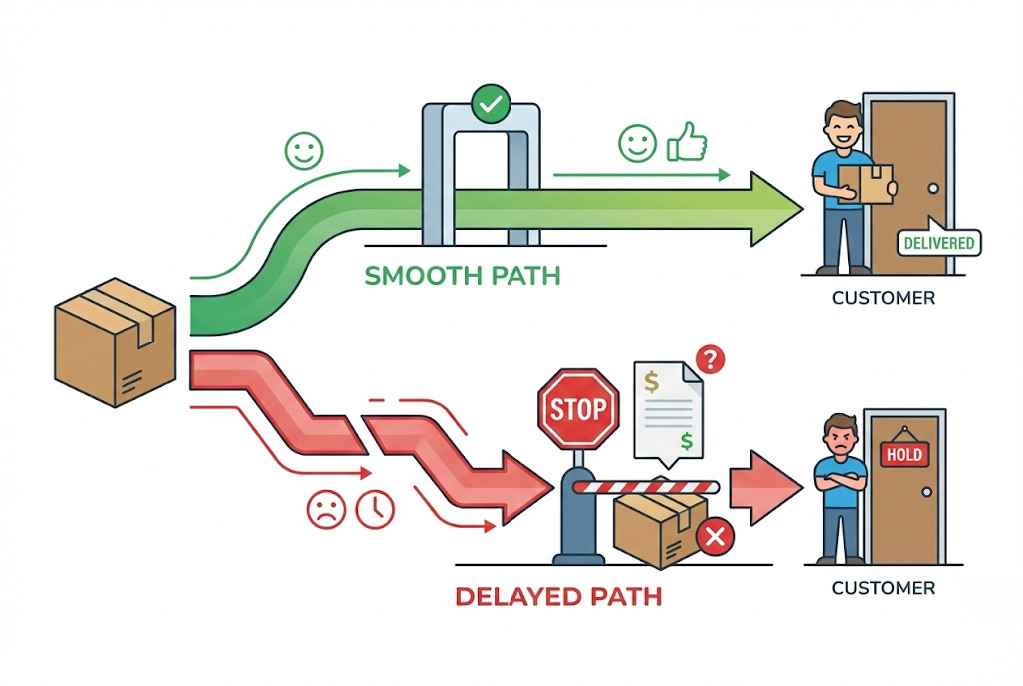
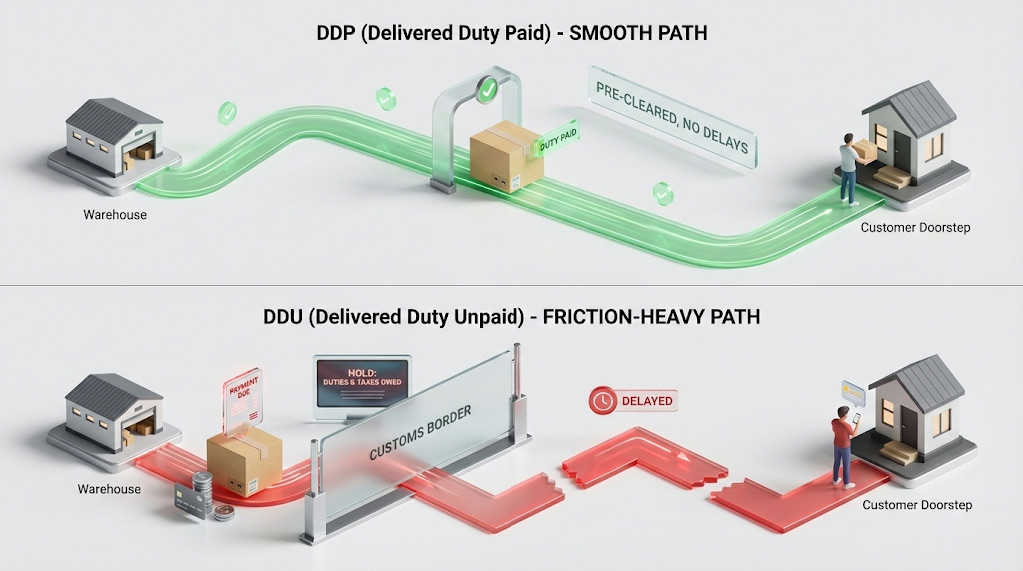
Consider the customer experience today. A shopper in Ohio buys a $40 vase from a UK boutique. Two weeks later, they get a courier invoice for $85 in duties and administrative fees. Why? Because the seller shipped Delivered Duty Unpaid (DDU).
The customer refuses to pay. The vase is abandoned. The brand loses the inventory, the shipping cost, and the customer.
This is the new baseline. Regulatory walls have gone up simultaneously across the globe. In the US, the border has thickened against parcels. In Europe, new packaging laws now dictate how much air you can ship in a box.
This guide is not about finding loopholes. The loopholes are closed. This is about doing the unglamorous, critical work of building a supply chain that can survive the scrutiny of 2026.
Redefining the Trade: What Is International E Commerce?
We used to define international e-commerce by marketing reach. Today, we must define it by liability. It is the digital sale of goods where the seller of record and the end consumer reside in different customs territories.
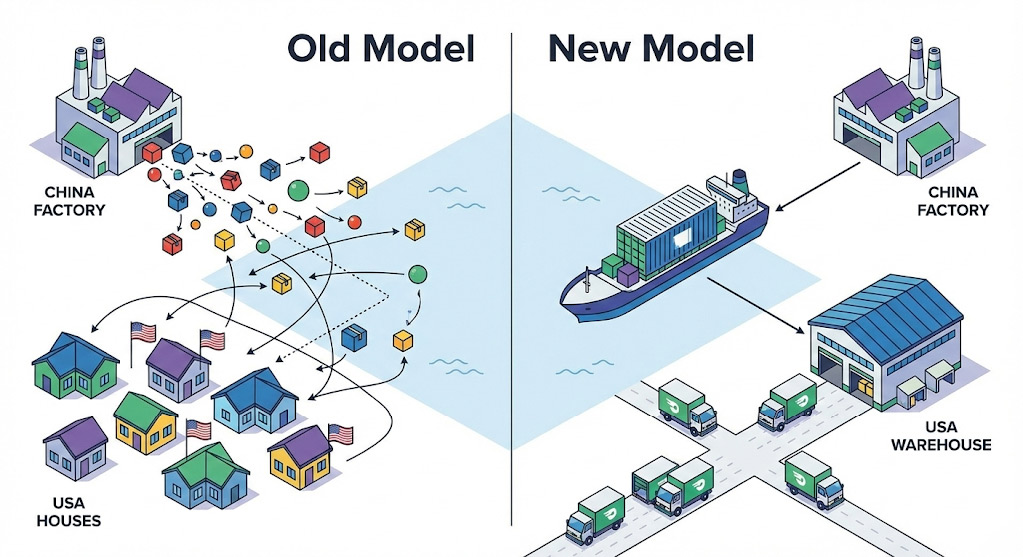
It is the atomization of global trade. Instead of moving 10,000 units in a container with one customs entry, we are moving 10,000 units with 10,000 separate entries. Regulators have spent years catching up to this model. Now they have.
The US de minimis suspension means every single package entering the US is now a commercial entry. There is no floor. A $10 t-shirt faces specific duty rates. If you use postal networks without precise data, you face flat-rate penalties ranging from $80 to $200 per item.
This has forced a migration. The economics of air-shipping cheap items directly to consumers no longer work. Brands are being forced to consolidate inventory into local 3PLs or Foreign Trade Zones to process bulk entries.
The result is a “glass pipeline.” Regulators can see the product, value, seller, and tax liability at every stage. If your business relies on opacity, it is obsolete.

The Squeeze: How Does Ecommerce Affect Small Businesses?
The narrative that tariffs only hurt global giants is false. The giants have bonded warehouses and in-house customs brokers. The entities bleeding in 2026 are the small to mid-sized businesses.
We must ask, how does ecommerce affect small businesses in this new era? It acts as a filter. It filters out the amateurs.
The Dropshipping Pivot
The classic dropshipping model faces an existential crisis. Under the old rules, you could sell a $30 gadget sourced for $10 with zero duties. The margin was healthy.
Now, that gadget incurs a tariff and a carrier brokerage fee that can exceed $15. The margin evaporates. To survive, businesses must pivot to a bulk-import model. They must buy inventory upfront and ship containers to local fulfillment centers. This requires capital that many lightweight models lack.
The Inventory Fracture
Brands are now forced to hold inventory in the local markets they serve. If you are a UK brand selling to the US, you can no longer efficiently fulfill from London. You must commit stock to a New Jersey warehouse.
This fractures your inventory. You might be overstocked in the UK and stocked out in the US. You cannot easily move stock back without re-importing it. This drives up working capital requirements and demands better demand forecasting.
Money Moves: The Payment Gateway Trap
In this high-cost environment, every basis point of margin matters. Yet, many founders treat their ecommerce payment gateway as a commodity. They are not.
The Trap of Blended Pricing
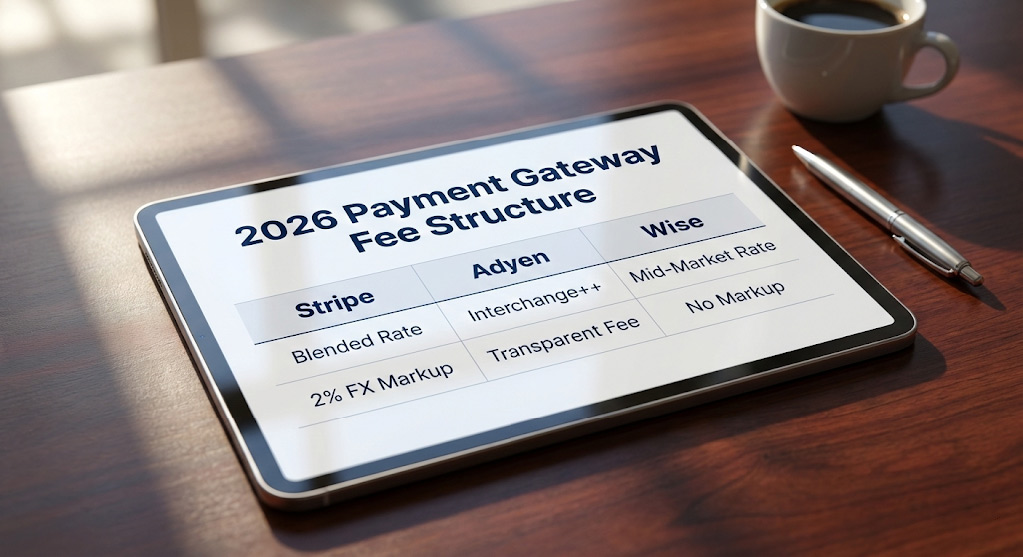
Most small businesses start with blended pricing, like Stripe’s standard 2.9% + $0.30. It is simple. But it masks the true cost. The provider charges a markup on every transaction regardless of the actual underlying cost.
For businesses scaling internationally, “Interchange++” is often the superior model. You pay the exact fee charged by the card issuer plus a small, transparent markup. Adyen is the primary player here. For a merchant selling into Europe where interchange caps are low, this can be significantly cheaper than a flat rate.
The FX Bleed
The real pain happens in cross-border settlements. If a US customer buys in USD from a UK store settling in GBP, conversion fees apply.
Your ecommerce payment system likely charges a markup on the exchange rate. Stripe typically adds a 1% to 2% fee on top of the mid-market rate. PayPal can charge upwards of 3% to 4%.
Mature brands are bypassing this by establishing local entities. By opening a US bank account, a foreign brand can accept USD domestically. They avoid the international card surcharge and FX fees on every transaction. They can then convert funds in bulk using treasury services like Wise Business at the mid-market rate.
| Feature | Stripe | Adyen | Wise Business |
| Pricing Model | Blended (Fixed %) | Interchange++ | Mid-Market Rate |
| Best For | Startups, Dev Teams | High Volume (> $5M) | Treasury & B2B |
| FX Markup | ~1% to 2% | Transparent Markup | ~0.43% (varies) |
Logistics & Packaging: The Green Tape
While the US fights a trade war with tariffs, the EU is fighting with bureaucracy. The Packaging and Packaging Waste Regulation (PPWR) applies from August 12, 2026. It fundamentally alters fulfillment.
The 50% Void Space Rule
The EU now mandates that empty space in transport packaging must not exceed 50%. Paper, bubble wrap, and air pillows count as empty space. You cannot just stuff a large box with filler anymore.
This forces “right-sizing.” Brands must invest in box-on-demand technology or stock a wider variety of box sizes. A brand shipping a lipstick in a standard 6x6x6 box is now legally non-compliant.
The End of DDU
Shipping Delivered Duty Unpaid (DDU) to the US or EU is a strategic error. It creates “sticker shock” at the door. Customers refuse the package. You pay for the return shipping plus the original duties.
The only viable path is Delivered Duty Paid (DDP). You must calculate and collect duties at checkout. Tools like Zonos or Avalara are essential here. They integrate into your cart to calculate the exact duty based on the HS code and location.
Pricing & Profitability: The Landed Cost Reality
We must abandon “Cost + Markup” pricing. It is insufficient. We need to use a “Total Landed Cost” model.
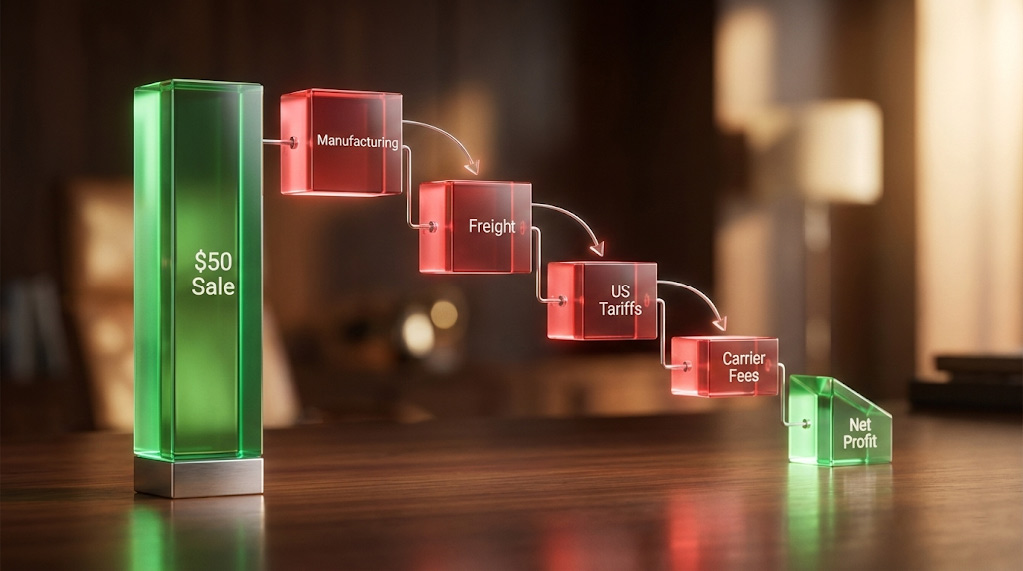
The formula is painful but necessary. Landed Cost equals Manufacturing Unit Cost plus Freight, Insurance, Duties, Merchandise Processing Fees, Carrier Brokerage, and 3PL Handling.
In the old world, duties were often zero. In 2026, a $20 item might carry a $2 duty and a $15 carrier disbursement fee if shipped individually. That kills unit economics.
The Free Shipping Trap
Free shipping is a powerful conversion driver. It is also dangerous for border e-commerce. If you absorb the duties and the shipping, you might lose money on every order.
Smart brands are moving to “Free Shipping over $150.” This encourages larger basket sizes. A larger basket dilutes the fixed costs of brokerage and freight across multiple items. Bundling is your best defense against fixed logistics costs.
Operational Best Practices: Data is the Product
In 2026, your data is your product. Without accurate data, your physical product sits in a customs hold.
The HS Code Imperative
The Harmonized System (HS) code is the DNA of your product. Getting it wrong is expensive. If you classify a polyester shirt as cotton, you are committing fraud. If you do the reverse, you are burning cash.
Never guess. Use professional classification tools. The US now requires strictly validated 10-digit HTS codes. A vague description like “gift” or “apparel” will get a package rejected or hit with a flat-rate penalty.
Reverse Logistics and Duty Drawback
Returns can kill a cross-border business. The cost of shipping a return back to the origin often exceeds the item’s value.
Implement “refund-less resolutions” for low-value items. It is cheaper to refund the customer and let them keep the item than to pay for return shipping and re-import duties.
For higher value items, use local consolidation hubs. If you do export returns back to your home country, ensure you file for Duty Drawback. This allows you to reclaim up to 99% of the US duties paid on the original import. It is free money that most brands leave on the table.
Illustrative Case Example: The “Who Gives A Crap” Strategy
Who Gives A Crap (WGAC) sells toilet paper. It is bulky, low-value, and mostly air. It is the absolute worst category for cross-border shipping. Yet, they scaled globally.
Their strategy was decentralization. They didn’t try to ship individual boxes from Australia to the world. They established manufacturing and warehousing nodes within their target markets (UK, USA, Europe).
They shipped data, not products.
Orders placed on their UK site route to a UK 3PL. They use local currency and local language. They treat each region as a domestic business. This bypassed the cross-border logistics nightmare entirely for the final mile. They accepted the complexity of managing multiple entities to gain the simplicity of domestic shipping rates.
Conclusion: Resilience in a Walled World
The borders of 2026 are not closed. They are gated. The toll to pass is data, compliance, and tax.
For the founder and the operator, the path forward requires a shift in mindset. You must move from a focus on “growth hacking” to “operational engineering.” Revenue growth means nothing if duties and returns eat the margin.
The brands that win will not be the ones with the flashiest ads. They will be the ones with the most boringly reliable back-end operations. They will be the ones who calculate landed cost to the penny. They will be the professional importers.
The opportunity is still immense. Global demand hasn’t vanished. But the right to serve that demand is now reserved for those who respect the mechanics of the border.
The 2026 Cross-Border Playbook
- The “Free Ride” is Over: The US ended the $800 de minimis exemption. Every shipment is now a taxable event. Expect higher costs and stricter paperwork.
- Ship Bulk, Not Single: Direct-to-consumer shipping from overseas is financially toxic for low-value items. You must move inventory to local warehouses (3PLs) in your target countries.
- DDP is Mandatory: Never ship “Delivered Duty Unpaid.” Surprise tax bills at the doorstep kill customer loyalty. Collect duties at checkout.
- Watch Your Void Space: The EU’s new PPWR law penalizes packages with more than 50% empty space. Audit your packaging now.
- Payment Strategy: Move away from flat-rate gateways if you have volume. Use “Interchange++” pricing (Adyen) or local entities with treasury accounts (Wise) to save on FX fees.
- Data Accuracy: Your HS Codes must be perfect. Vague descriptions lead to flat-rate penalties and customs holds.
- Returns: Avoid shipping returns back to origin. Use local consolidation or refund-less resolutions for cheap items.