When someone asks ChatGPT, Perplexity, or Google SGE “best CRM for small business,” they do not see 10 blue links anymore. They get a synthesized answer with citations.
AI search engine optimization is the practice of structuring content so AI systems cite YOUR website as the authoritative source in these generated responses.
Unlike traditional SEO (ranking higher in Google), AI SEO focuses on being the answer AI models extract and attribute. You still want clicks. But first you need the citation. This matters because AI answers now capture a massive share of commercial search volume. If you are not structured for AI extraction, competitors will dominate the answers users actually read.
AI Search Engine Optimization (AI SEO): Technical and content practices that make your website the preferred source when AI models generate answers to user questions.
What Is AI Search Engine Optimization?
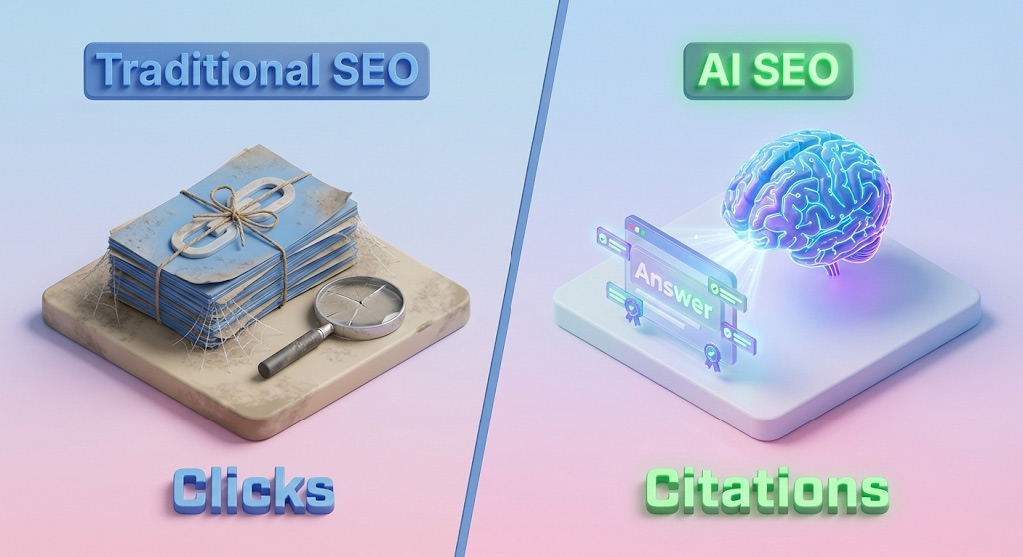
AI search engine optimization is the strategic process of optimizing content for retrieval by Large Language Models (LLMs) and Answer Engines. It is distinct from traditional SEO. Traditional SEO targets a position on a page. AI SEO targets inclusion in a generated answer.
We used to optimize for a crawler that indexed links. Now we optimize for a model that infers answers.
The stakes have changed in 2026. Data from industry studies shows that approximately 65% of Google searches are zero-click to an external website. The user gets their answer directly on the results page. This is the “Zero-Click” reality.
If your content is not the source of that answer, you are invisible.
Consider a real-world example. Search for “best project management software for creative agencies” on Perplexity. Does the AI list your tool? Or does it list your competitor? The brands that appear here are not necessarily the ones with the most backlinks. They are the ones with the highest “Information Gain” and the clearest entity signals.
This shift has created three distinct disciplines. There is SEO (Search Engine Optimization) for traditional links. There is AEO (Answer Engine Optimization) for direct answers. And there is GEO (Generative Engine Optimization) for influencing the creative output of models like Claude or Gemini.
What Is Optimization in AI?
To master this new landscape, you must understand the machine’s perspective. You need to know what is optimization in ai.
In the context of machine learning, optimization is the mathematical process of adjusting a model to minimize errors. A model wants to make the best possible prediction. It uses a “Loss Function” to measure how wrong it is.
If an AI generates an answer that is vague or factually incorrect, the “loss” is high. The model is trained to avoid this. It seeks content that reduces this loss.
When we optimize for AI, we are trying to lower the “loss” for the model. We provide structured, verified facts. We use clear language. We make it computationally easy for the AI to process our content and generate a high-confidence answer.
What Is an Optimization Problem in Search?
For a search engine in 2026, every user query is a math problem. Specifically, what is optimization problem in this context? It is the challenge of selecting the best possible answer from billions of documents in milliseconds.
- Input: A user asks, “Plan a 3-day vegan meal plan under $50.”
- Constraint: The AI must answer quickly, accurately, and safely.
- Solution: The AI retrieves specific data points (entities) that fit these constraints.
The AI is not “reading” like a human. It is calculating probabilities. It predicts which tokens (words) best satisfy the user’s intent.
Your content is the training data for this calculation. If your content clearly defines entities (e.g., “Tofu is a protein” and “Tofu costs $2”), you solve the optimization problem for the AI. You make it statistically probable that the AI will use your content to build the answer.
What Is Optimized Content for AI Search?
So, what does this look like in practice? What is optimized content for an AI world?
It is content that prioritizes “Information Gain” over fluff. It answers questions directly. It uses data structures that machines can parse.
Characteristics of AI-optimized content:
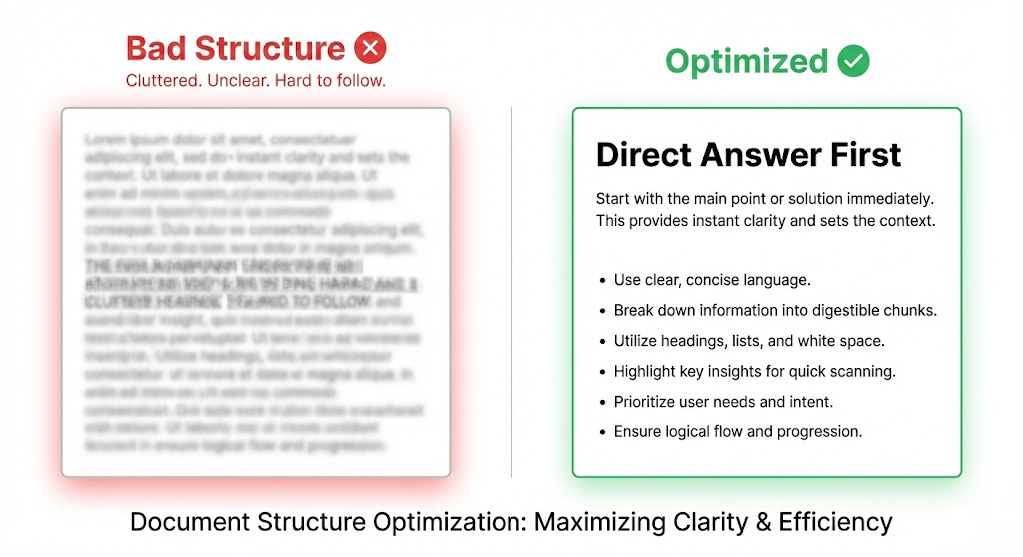
- Direct Answers: The core question is answered in the first 200 words.
- Question-Based Headers: H2 and H3 tags mirror actual user queries.
- Structured Data: Schema markup is used to explicitly define entities.
- Specific Claims: Statements are backed by data (e.g., “Battery lasts 12 hours” vs. “Long battery life”).
- Entity Relationships: The content connects the brand to specific topics and concepts.
Research suggests that opening paragraphs that answer the query immediately are significantly more likely to be cited. The AI’s “context window” is limited. It prioritizes the text that appears to be the direct solution.
How to Improve Search Engine Optimization for AI
If you want to know how to improve search engine optimization for AI, you must abandon the old playbook of keyword stuffing. Follow these five steps.
Step 1: Answer Questions Directly (First 200 Words)
Use the “Inverted Pyramid” style of journalism. Place the direct answer at the very top.
If the H1 is “How to fix a leaky faucet,” the first sentence should be the solution. “To fix a leaky faucet, turn off the water supply and replace the washer.”
Do not start with a story about why leaky faucets are annoying. The AI interprets that as noise. It may discard the page before reaching the solution.
Step 2: Use Question-Based Headers
Structure your article like a FAQ. AI models are trained on Question-Answer pairs.
Instead of an H2 like “Benefits,” use “What are the benefits of this software?”
This maps your content directly to the user’s intent. It helps the AI retrieve the specific section needed to build an answer.
Step 3: Add Structured Data (Schema Markup)
Schema markup is the code that translates your content for the machine. It is non-negotiable in 2026.
Use FAQPage schema for your Q&A sections. Use Article schema to establish authorship.
This code tells the AI explicitly what the data means. It turns text into a database. Pages with robust schema are cited more frequently because the AI has higher confidence in the data.
Step 4: Optimize for Conversational Queries
Users talk to AI like a friend. They ask, “Where can I find a cheap gym near me that is open 24 hours?”
Your content should use natural language. Include “People Also Ask” questions in your text.
Avoid robotic keyword strings. Write for the “Long Tail” of conversational intent.
Step 5: Build Authority Signals
AI models rely on a “Knowledge Graph.” They trust facts that are corroborated by other trusted sources.
You need citations from authoritative publications. You need positive sentiment in forum discussions like Reddit.
If the AI sees your brand mentioned as an expert on multiple high-authority sites, it assigns a high trust score to your content.
How to Optimize a Website for AI Search
To fully address how to optimize a website for ai search, you must look beyond the content. You need the right technical infrastructure.
The llms.txt Standard
In 2026, a new standard called llms.txt gained traction. This file acts like a “VIP Menu” for AI agents.
It provides a simplified, markdown-friendly version of your most important content.
It strips away ads and design elements. It hands the AI exactly the data it needs to cite you. Implementing this file is a strong signal that your site is AI-ready.
Comparison Table: Traditional SEO vs AI SEO
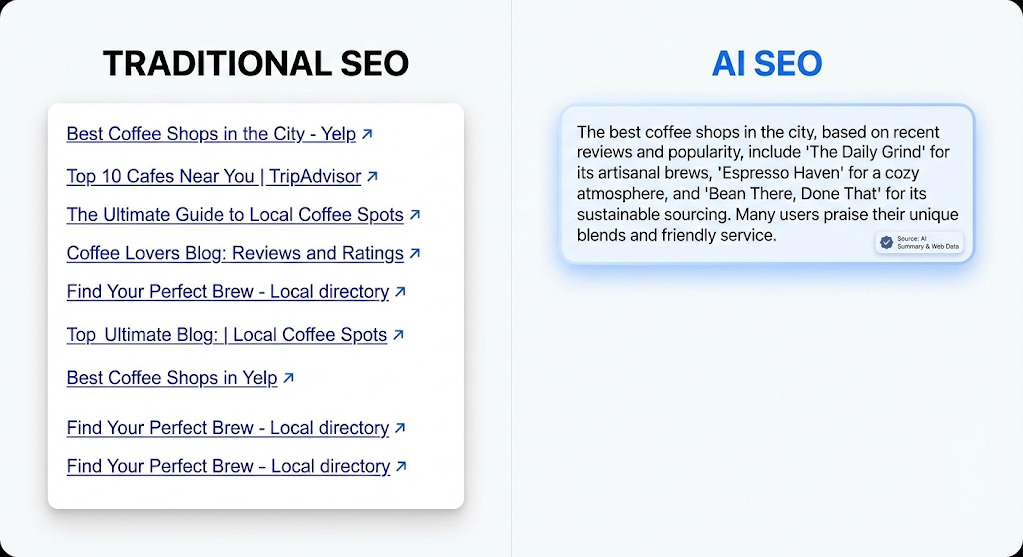
| Aspect | Traditional SEO | AI Search Engine Optimization |
| Goal | Rank #1-3 in blue links | Be cited in the AI answer |
| Content Unit | Full Web Page | Passage / Paragraph |
| Primary Signal | Backlinks | Authority + Structure (E-E-A-T) |
| Query Type | Keywords (“best shoes”) | Questions (“What are the best shoes for flat feet?”) |
| Success Metric | Clicks & Traffic | Citations + “Share of Answer” |
Implementation Checklist
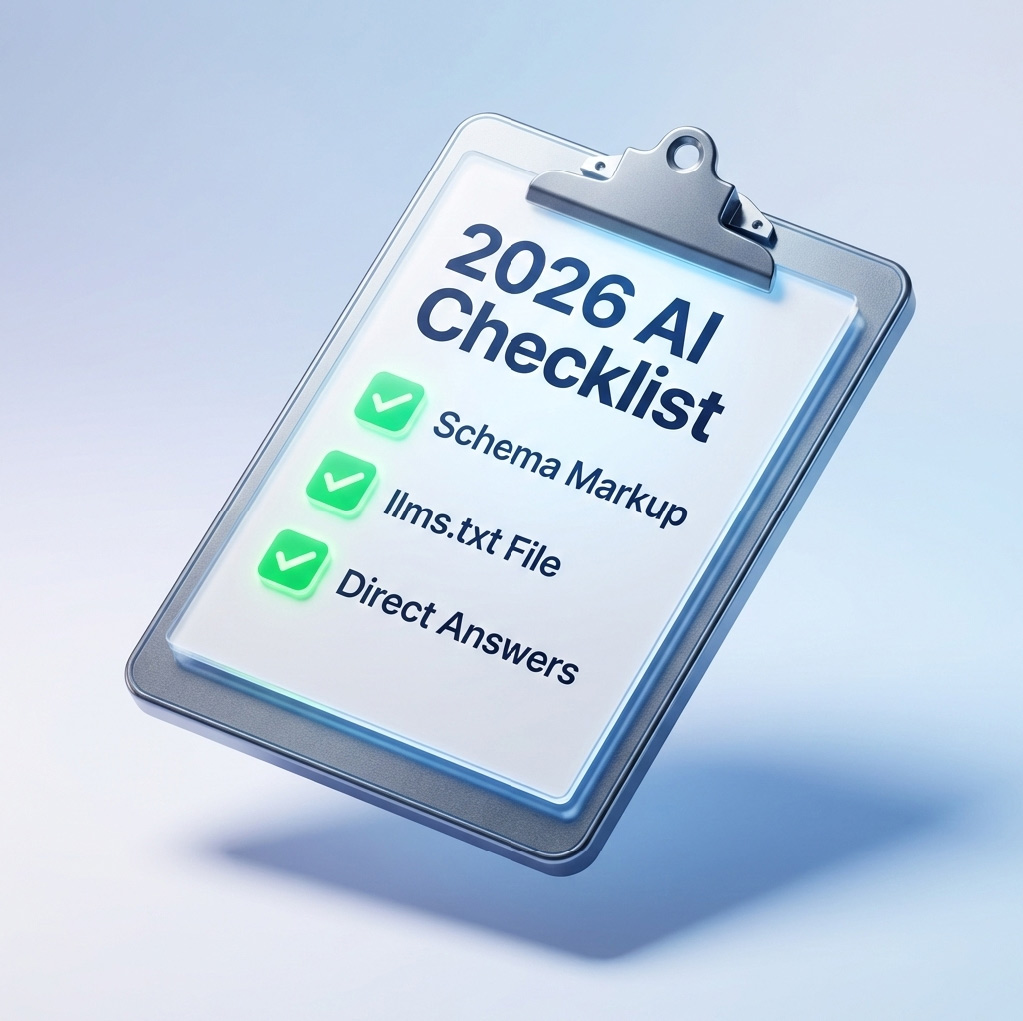
- [ ] Audit Content: Does the first paragraph answer the H1 title?
- [ ] Schema Implementation: Is JSON-LD present for Articles, Products, and FAQs?
- [ ] llms.txt Creation: Have you created a text-only map for AI agents?
- [ ] Entity Clarity: Is your “About Us” page clear on who you are?
- [ ] Header Optimization: Are H2s phrased as questions?
- [ ] Fact Verification: Are all statistics cited with credible sources?
- [ ] Visual SEO: Do images have descriptive Alt Text for multi-modal search?
- [ ] Local SEO: Is your NAP (Name, Address, Phone) consistent?
- [ ] Digital PR: Are you being mentioned in industry newsletters?
- [ ] Speed Check: Is the site fast enough for rapid AI crawling?
Real-World Examples of AI SEO Success
SaaS: KrispCall
KrispCall, a cloud telephony startup, used “Programmatic SEO” to dominate AI search. They created thousands of structured pages for specific area codes (e.g., “Get a 213 Area Code”).
Each page followed a strict data template.
Traffic exploded by over 1,900% to 2 million visits. AI models cited them as the definitive source for area code data because the structure was so predictable.
Real Estate: Flyhomes
Flyhomes scaled their visibility by becoming a data authority. They built “Cost of Living” guides for thousands of cities.
They aggregated hard data like tax rates and housing prices into clear tables.
These data-rich pages accounted for over 50% of their traffic. AI engines prefer citing pages with hard data tables over vague blog posts.
Health: ZOE
ZOE used Authority (E-E-A-T) to win in the sensitive health niche. They ensured every piece of content was reviewed by PhDs.
They used “Author” schema to link to academic credentials.
By proving expertise, ZOE became a primary citation for nutrition queries. They bypassed generic health sites that lacked deep verification.
AI SEO vs Traditional SEO: The Comparison
The shift isn’t just about technology. It is about geography and intent.
United States:
Google’s AI Overviews are dominant here. The market is highly commercial.
Optimization focuses on speed and direct answers. Users want to buy or solve a problem immediately.
European Union:
Strict privacy laws (GDPR, AI Act) affect how AI models scrape data.
Optimization here requires a focus on compliance and transparency. Trust signals are paramount.
India:
This is a mobile-first, voice-first market. AI adoption is rapid, with Google AI Mode having over 100 million users.
Optimization focuses on conversational/voice queries. Visual SEO is also critical for multi-modal search behavior.
Common AI SEO Mistakes (And Fixes)
Mistake 1: Keyword Stuffing
AI reads for meaning, not just keywords. If you repeat “best CRM” 50 times, the AI sees it as noise.
Fix: Focus on “Entity Density.” Mention related concepts (e.g., “sales pipeline,” “lead scoring”) to show depth.
Mistake 2: Missing Structured Data
Without Schema, the AI has to “guess” what your data means. This increases the chance of error.
Fix: Use a plugin or tool to auto-generate JSON-LD for every page.
Mistake 3: Thin Content
AI ignores content that adds no “Information Gain.” If you just rewrite top ranking posts, you add no value.
Fix: Add original data, unique expert quotes, or proprietary case studies.
Mistake 4: Missing Conversational Phrasing
Formal, stiff language feels unnatural to chat models. It is less likely to be selected for a conversational answer.
Fix: Read your content out loud. Does it sound like a helpful human answering a question?
FAQ – AI Search Engine Optimization
Do I still need traditional SEO if I do AI SEO?
Yes. Traditional SEO is the foundation. If search engines cannot crawl your site, AI agents cannot read it. Think of SEO as the library card and AI SEO as the book content.
How long does AI SEO take to work?
It can be faster than traditional SEO. AI models update their “knowledge” frequently. Highly structured content can be picked up by AI summaries in a matter of weeks.
What tools help with AI search optimization?
Tools like Semrush and Ahrefs now track “AI Overview” rankings. Schema validators are essential. You can also use Perplexity to “test” your site by asking it questions about your brand.
Does AI SEO work for local businesses?
Absolutely. AI is heavily used for queries like “best plumber near me.” Local businesses must optimize their Google Business Profile to be cited.
How is AI SEO different in different countries?
In regions like the EU, privacy laws affect data scraping. In mobile-heavy markets like India, voice optimization is critical. Your strategy must adapt to local regulations.
Key Takeaways
- AI SEO is about Citation: The goal is to be the “Source of Truth” cited by the AI. You are not just fighting for a link.
- Answer First: How to improve search engine optimization starts with answering the user’s question in the first 200 words. Use the inverted pyramid.
- Structure Matters: Use Schema markup and llms.txt. Speak the AI’s language.
- Hybrid Approach: You need to optimize for both the AI (for visibility) and the human (for conversion). Traffic might drop, but the quality of that traffic will rise.

Disclaimer: This article is for informational purposes only. The field of AI search is evolving rapidly. Strategies effective in 2026 may change as models update.