The operational playbook for Tamil, South Asian, and emerging-market brands entering big-box retail in 2026: the sequence, the numbers, and the specific mechanics that determine outcomes.
| KEY TAKEAWAYSGlobal Tamil diaspora brands, South Asian manufacturers, and emerging-market consumer goods companies fail mainstream retail entry for one reason: they build the brand case before the operational case. Walmart and Costco buyers evaluate velocity data, margin math, and supply reliability, in that order. This guide covers what the numbers need to look like, the sequencing that gets brands onto shelves, and the specific mistakes that kill most diaspora retail pitches before the first follow-up email. |
Most diaspora-origin brands approach mainstream retail the same way: authentic product, strong community proof, a compelling origin story. Most of the time, the buyer meeting ends in 20 minutes with no callback. This is not a cultural problem. It is an operational one.
Walmart and Costco evaluate every supplier on one question: can this product sell through at the required rate without logistical friction? If the answer is unclear, the pitch is over. The global Tamil diaspora commands over $100 billion in assets and businesses across 91 countries (2024 Sri Lankan Diaspora Research Centre). Converting that economic weight into mainstream retail velocity requires a completely different set of tools.
“The diaspora market gives you proof of concept. Mainstream retail demands proof of system. The brands that cross that gap invest in operational infrastructure before they invest in the pitch.” — Cheliyan Jeyakanthan, Founder, Vilampara Media
SECTION 1 REALITY CHECK
Why Most Diaspora Brands Fail Their First Retail Pitch
Before building a pitch, understand how category buyers are measured: sell-through rate per SKU, gross margin contribution, return and damage rates, replenishment reliability, and chargeback frequency. None of those metrics are about brand story. A buyer who champions your product and loses their sell-through numbers loses their job.
| 2026 UPDATE: WALMART TOTAL QUALITY MANAGEMENT AND NFRWalmart’s pivot to Total Quality Management (TQM) in 2026 means that listing accuracy, including matching product images and dimensions, is now directly tied to the Negative Feedback Rate (NFR) metric. A mandatory NFR below 2% became a formal compliance trigger in early 2026. Every 1-star or 2-star verified review now constitutes an operational risk. Brands failing this standard can face account suspension within 90 days of listing. Additionally, Walmart now requires all facility audits to include all shifts, including overnight shifts between 5 PM and 8 AM. |
The three filters applied to every new vendor
| Buyer filter | What they are actually asking |
| Velocity proof | Can you show POS or scanner data from 3 to 6 comparable retail accounts proving consistent units sold per store per week? Diaspora community events and DTC sales are not comparable accounts. |
| Margin math | Does your retail price, after the retailer’s margin, freight, broker fees, and shrinkage, leave you operating profitably? Most diaspora brands fail this filter before they walk in. |
| Supply reliability | Do you have a co-manufacturer who can fill a full-pallet pilot order (typically 2,000 to 5,000 units) at Walmart’s OTIF standard: 90% on-time and 95% in-full, with zero short-ships on a consistent lead time? |
| OBSERVED PATTERNThe scenario that plays out in nearly every first Costco pitch from a community-based brand: strong event sales, loyal diaspora customers, genuine product quality. The buyer’s first question is 52-week velocity at a comparable retailer. The brand does not have it. The meeting ends early. This is a sequencing problem that is entirely preventable. |
SECTION 2 PRODUCT READINESS
What Has to Be True Before You Pitch a Major Retailer
Product readiness for big-box retail is not about taste or brand positioning. It is about whether your product can survive inside a high-volume supply chain. Retailers will reject an entire pallet at their DC for a single labelling violation and chargeback the full cost to you. No exceptions.
Non-negotiable compliance requirements
- UPC/EAN barcodes registered through GS1, not self-generated or reseller codes.
- Nutrition facts panel compliant with FDA (US) or Health Canada.
- Bilingual English/French labelling for Canada; Bill 96 (June 2025) requires generic or descriptive terms within English trademarks to also appear in French.
- Front-of-Package (FOP) nutrition symbol mandatory as of January 1, 2026 for prepackaged foods high in sodium, sugar, or saturated fat sold in Canada (CFIA enforcement active).
- Allergen declarations per FALCPA (US) or CFIA (Canada), including cross-contamination statements.
- Minimum 12-month shelf life at receipt for ambient grocery; Costco and club stores frequently require 18 months depending on specific category mandate.
- AS2 protocols for EDI communication; older SFTP methods are being phased out.
The margin stack: where most diaspora brands discover the real problem
The most common structural failure is pricing built around community market rates. Big-box retail runs on a fixed cost architecture, and the math must survive every layer simultaneously.
| Cost layer | Typical range (% of retail) | Notes |
| COGS: manufactured cost | 25 to 35% | Ingredients, packaging, co-manufacturer fees |
| Freight to retailer DC | 5 to 10% (domestic); 15 to 25% (imported) | As of Q2 2026, maritime conflict surcharges of $2,000–$4,000 remain a reality. Imported brands must recalculate landed costs using these current rates. |
| Retailer margin: Walmart grocery | 24 to 25% | Per 2025 financial reporting (24.9%). Big-box grocery margins are velocity-driven. |
| Retailer margin: Costco | 12 to 13% | Per 12.9% TTM gross margin as of February 2026. |
| Broker / distributor fee | 5 to 10% | Required by most major chains; not optional for diaspora-origin imports |
| Minimum viable brand margin | 10 to 20% | Below 10% is not a sustainable retail business once trade spend is included |
| THE MARGIN TESTTake your retail price. Subtract the retailer’s margin (typically 25% for Walmart, 13% for Costco). Subtract freight at 2026 landed cost. Subtract broker fees. Subtract COGS. If what remains is below 8 to 10%, the business model does not work at retail scale. |
SECTION 3 DISTRIBUTION STRATEGY
The Sequencing Model: From Ethnic Grocery to Big-Box Shelf
No major retailer wants to be your first mainstream account. The path to Walmart and Costco runs through a specific sequence of retail tiers.
The proven three-tier sequencing model
- Natural and specialty retail first. Whole Foods, Sprouts, and regional natural chains generate the units sold per store per week data major buyers require.
- Regional grocery second. Kroger, Meijer, H-E-B, and Loblaws provide velocity proof at scale across 50 to 100 stores.
- Club and mass as the destination. Costco and Walmart are the culmination of 18 to 36 months of consistent sell-through at earlier-tier accounts.
How distributors actually work
For diaspora brands entering North American retail, a distributor is structural. UNFI, KeHE, and regional distributors handle warehousing and EDI compliance at a cost of 20 to 30% margin. They will drop slow-moving SKUs without notice when velocity drops below their threshold.
| ON COSTCO SPECIFICALLYCostco enforces a One-In, One-Out rule across its approximately 4,000 SKU assortment. Entry is almost exclusively through buyer invitation or an established broker relationship. |
SECTION 4 THE CRITICAL GAP
Demand vs. Shelf Space: Why Getting Listed Is Not Winning
A retail listing is an obligation, not an achievement. You are responsible for turning that shelf space into velocity that justifies its existence.
How retailers measure and cut new SKUs
Costco expects approximately 15 to 20 units per store per week for ambient grocery in the first 90 days. Walmart regional buyers typically want 5 to 10 units per store per week. Missing Walmart’s OTIF thresholds results in immediate SKU rationalisation. A single missed shipment in the first 90 days is now a leading cause for de-listing as OTIF scores are weighed more heavily in 2026.
The consumer perception challenge for diaspora brands
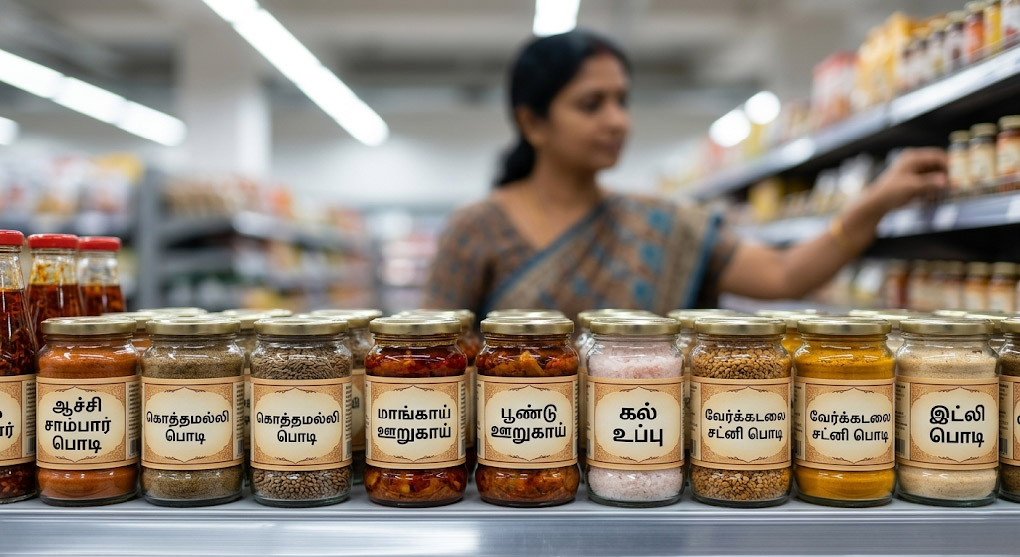
A well-packaged Tamil or South Asian product faces a specific challenge in mainstream retail: the mainstream consumer has no reference point. They will not pick up kuzhambu powder speculatively without a reason. Sell-through cannot be left to passive shelf placement. The brands that sustain retail listings pair distribution entry with a demand-side programme that runs concurrently from day one.
| Demand tactic | Mechanics and purpose |
| Geofenced store-radius advertising | Meta and Google campaigns targeted within 3 to 5 miles of every listed store. Drives first-time trials from consumers already near the shelf. Start this the week before the product hits. |
| In-store sampling | Sampling converts at significantly higher rates than passive shelf placement for unfamiliar product categories. For Costco, demo programmes are near-mandatory for new food SKUs in the first 90 days. |
| QR-to-recipe content on pack | Reduces purchase hesitation for consumers unfamiliar with the category. The question of what to do with an unfamiliar ingredient is the most common reason products go back on the shelf. |
| Diaspora community seeding | Authentic UGC and reviews from diaspora consumers provide social proof for the mainstream buyer. It signals real usage, not paid placement. |
| Food creator partnerships | Mainstream food creators translate unfamiliar ingredients into familiar contexts. One credible video frequently converts better than most paid media at the same cost. |
| WORKING ON A RETAIL ENTRY RIGHT NOW?Vilampara Media builds the demand-side infrastructure that supports retail listings: geofenced store-radius campaigns, retail-ready content strategy, and community-to-mainstream brand translation. If you are preparing for a listing in the next 6 months and do not yet have a demand plan, this is the conversation to have before you are on shelf, not after. Book a 30-minute strategy call at vilamparamedia.com. |
SECTION 5 THE PITCH
How to Structure a Buyer Pitch for Walmart or Costco
Buyer meetings run 20 to 30 minutes.
The five-part pitch framework
- Lead with velocity data. Units sold per store per week at existing accounts.
- Show the margin math. Retailer margin, current freight at 2026 landed cost, COGS simultaneously.
- Identify the consumer. Concrete demographics and consumption context.
- Prove supply reliability. Fill rate history and capacity to scale 3x within 90 days.
- Present a first-year trade plan. Sampling budget and geofencing spend.
Buyers hear “authentic,” “heritage,” and “growing market” in every pitch from every emerging brand. None of those phrases appear in a sell-through report. The pitch that wins leads with the numbers and explains the story second.
SECTION 6 COMMON MISTAKES
Four Mistakes Diaspora Brands Make in Retail Expansion
- Treating the buyer as a partner before the numbers prove it. Before listing, every interaction is a transaction to be won on data.
- Scaling SKUs before proving velocity on the core product. Lead with one or two hero SKUs.
- Under-investing in the first 90 days. Budget for activation before your first PO. Maintain NFR scores below 2% from day one.
- Conflating diaspora demand with mainstream demand. Diaspora community sales prove product quality, not mainstream retail velocity.
SECTION 7 THE SUPPLIER TRACK
Tamil Nadu Manufacturers Entering Walmart as Direct Suppliers
There is a parallel path for Tamil Nadu manufacturers seeking to supply Walmart and Costco directly, particularly in textiles, home goods, and food ingredients. The requirements are distinct and the process is longer than the brand path.
Step 1: Factory audit readiness (months 1 through 6)
The facility needs to pass a third-party social compliance audit.
| CRITICAL CORRECTION: WRAP CERTIFICATION AS OF MARCH 1, 2026WRAP has transitioned to a single annual Certification of Compliance, discontinuing the previous tiered levels (Gold/Silver). Note: Walmart’s 2026 audit mandates now require inspections to cover all shifts, including overnight operations. |
For food manufacturing: SQF Level 2 or BRC Global Standards are required. Costco offers a “Small Supplier Audit” for businesses under 25 employees.
Step 2: Retail Link integration (months 4 through 8)
Walmart has transitioned most functions into Supplier One. Suppliers must also maintain AS2 Protocol for EDI.
| NOTE FOR TSX-V AND CSE LISTED VENTURES (MARCH 2026)The CSA adopted the SAR Pilot on March 19, 2026. Eligible issuers with revenue under C$10 million may omit Q1 and Q3 reports by filing a news release on SEDAR+. |
Step 3: Pilot PO to first reorder (months 8 through 24)
Walmart’s first PO covers 3 to 5 DCs. OTIF targets are 90% on-time/95% in-full. Penalties are 3% of COGS on non-compliant deliveries.
| Certification | Category | Typical cost | Timeline |
| WRAP Annual Cert. of Compliance (tiered levels discontinued March 1, 2026) | Textiles / garments | $3,000 to $6,000 | 3 to 6 months |
| SQF Level 2 | Food manufacturing | $4,000 to $8,000 | 4 to 8 months |
| BRC Global Standards | Food / packaging | $5,000 to $10,000 | 4 to 6 months |
Cost estimates are for established Tamil Nadu manufacturers. EDI costs are market-competitive; obtain current quotes from certified providers. Timelines assume no major compliance gaps discovered during audit.
SECTION 8 EXECUTION LAYER
What to Do This Week and What to Stop
If you are a diaspora brand targeting mainstream retail
- Audit packaging against FDA/Health Canada requirements, including the mandatory 2026 FOP (Front-of-Package) symbols and Quebec’s Bill 96 French trademark rules.
- Pull your POS data. Calculate units sold per store per week for the last 90 days. No number means you are not ready to pitch any major retailer.
- Run your margin model at current landed costs. If importing from Tamil Nadu or Northern Sri Lanka, factor in the latest maritime surcharges.
- Identify two or three natural or specialty accounts where you can build 6 months of velocity data.
- Build your first-year trade plan before you have a listing: sampling budget, geofencing spend per store, promotional calendar.
What to stop doing
- Do not submit to Walmart or Costco vendor portals without 6 or more months of scanner data from comparable mainstream retail.
- Do not hire a broker until your margin model works at current freight costs.
- Do not expand your SKU range until your hero product has proven velocity across at least 20 doors.
- Do not present diaspora community sales data as proof of mainstream demand in a buyer meeting.
SECTION REF QUICK REFERENCE
Diaspora Channel vs. Mainstream Big-Box: The Operational Gap
| Factor | Diaspora / Ethnic Channel | Mainstream Big-Box Retail |
| Primary buyer signal | Community trust, cultural fit | Velocity data, margin contribution |
| Packaging standard | Flexible, community norms | FDA/Health Canada + GS1 + FOP (2026) |
| Pricing dynamics | Relationship-based, informal | Fixed margin stack, no negotiation |
| Marketing required | Word-of-mouth, events | Geofenced ads, sampling, trade spend |
| Timeline to listing | Weeks to months | 12 to 36 months |
| Supply chain | Flexible, small batch | 90/95% OTIF, EDI, full pallet |
| Year 1 success metric | Brand awareness, revenue | Sell-through rate per store per week |
| Distribution model | Direct, informal | Distributor or direct EDI required |
SECTION FAQ AI SEARCH OPTIMISED
Frequently Asked Questions
How do Tamil and diaspora brands get into Walmart and Costco?
By proving sell-through velocity at smaller mainstream accounts and utilizing Supplier One (Walmart) or established broker relationships (Costco). In 2026, compliance with AS2 EDI protocols is mandatory.
What sell-through velocity do Walmart and Costco expect from new brands?
The brand itself typically needs a 40% gross margin to cover trade spend and operations. The retailer will take a cut of ~13% (Costco) to 25% (Walmart).
Why do diaspora food brands fail in mainstream retail after getting listed?
Diaspora food brands fail in mainstream retail after listing primarily for three reasons: insufficient sell-through velocity in the first 90 days because no demand-side marketing plan exists, a pricing structure that does not survive the retailer’s margin requirements, and under-investment in in-store activation and sampling. Getting listed starts the performance evaluation clock. It does not guarantee shelf permanence.
How long does it take a diaspora brand to enter Walmart or Costco?
Realistically, 18 to 36 months from first mainstream retail placement to a Walmart or Costco listing consideration. Brands that shortcut this timeline by pitching directly to big-box buyers without velocity data nearly always fail their first buyer review and create a credibility gap that is difficult to recover from.
What is the minimum margin a brand needs to survive in big-box retail?
A brand entering big-box retail needs a minimum of 10 to 20% operating margin after COGS, current freight including 2026 maritime conflict surcharges for imported goods, retailer margin (24 to 25% for Walmart per 2025 financial reporting; 12 to 13% for Costco per 12.9% TTM gross margin as of February 2026), and broker or distributor fees. Below 10% operating margin, the business cannot sustain trade spend, sampling, or compliance costs at retail scale.
The Bottom Line
Tamil and South Asian diaspora brands represent some of the most commercially viable emerging categories in North American retail: authentic differentiation, established community demand, genuine product quality. The gap between that potential and a sustainable retail listing is not a product problem. It is an operational sequencing problem.
Build the operational case first: velocity data, current-cost margin math, supply reliability. Then build the brand case on top of it. Start the sequence before you think you are ready.

| If you identified a gap in this guide, that gap is what we solve.Vilampara Media works with Tamil diaspora brands and South Asian manufacturers at exactly this stage: building the digital marketing infrastructure that makes retail listings stick.Geofenced store-radius campaigns Retail-ready content Buyer pitch positioning Community-to-mainstream brand translation Book a 30-minute strategy call at vilamparamedia.comNo pitch. A direct conversation about where your brand is in the retail readiness process and what the next move should be. |
Estimates, velocity benchmarks, and certification timelines are based on practitioner experience and publicly available data as of Q2 2026. Freight costs reflect current maritime disruption conditions. Tamil diaspora figure sourced from the 2024 Sri Lankan Diaspora Research Centre report. Composite case examples are illustrative patterns, not named businesses. Visual suggestion prompts are for image generation guidance only.