Why do heritage products stay trapped in ethnic aisles while global brands scale everywhere?
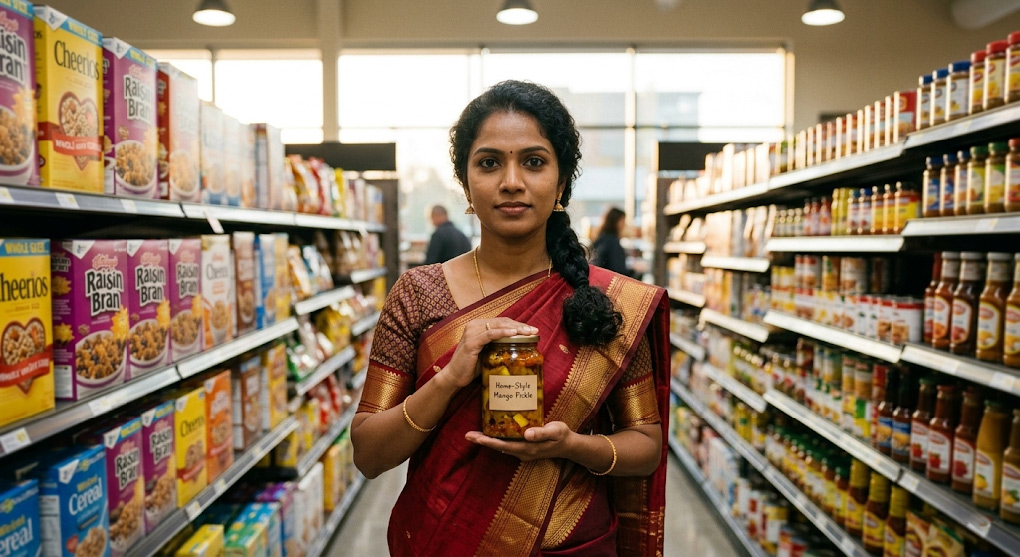
For many ambitious Tamil diaspora founders, the frustration is real. You have a product with superior ingredients, a deeper history, and better flavor profiles than anything currently sitting on a Walmart shelf. Yet, while a generic “protein bar” with synthetic additives secures a prime end-cap at Whole Foods, your authentic, nutrient-dense snack remains tucked away in a corner of a local specialty store, visible only to those who already know it exists.
The barrier is rarely the product quality. The barrier is a missing Brand Positioning Map.
To move a brand from a community secret to a household name in Western markets, you must transition from selling “culture” to selling “solutions.” This guide breaks down the operational and strategic shifts required to achieve brand positioning and strategy that resonates with the global consumer.
How does the Brand Positioning Map define retail success?
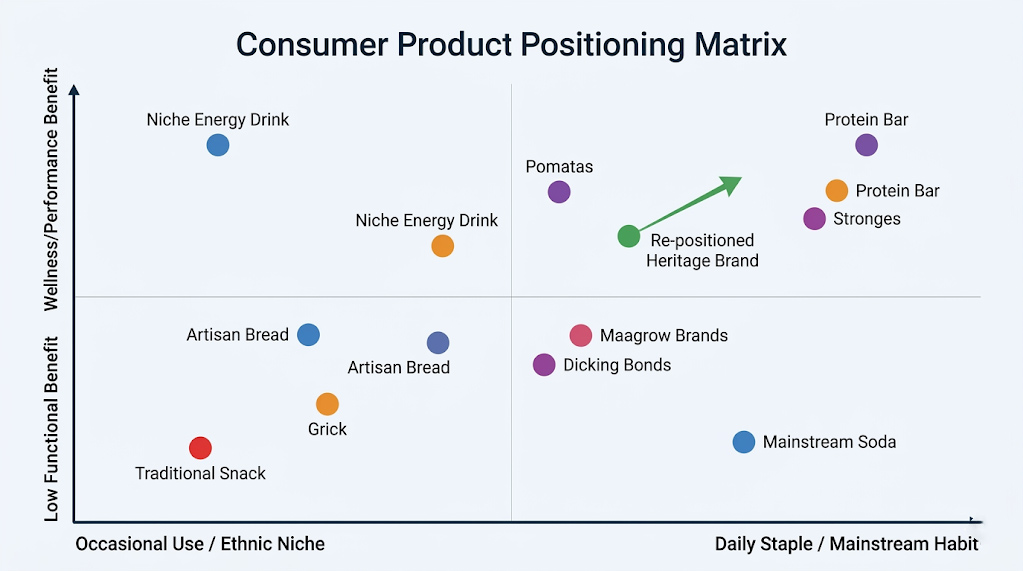
A Brand Positioning Map is a strategic visual tool used to identify where your product sits in the mind of the Western consumer relative to competitors. It measures two critical variables, typically “Price” and “Functional Benefit” (e.g., convenience, health, or status).
For heritage brands, this map reveals the “Ethnic Trap.” If your product is positioned solely on its heritage, the Western customer perception often categorises it as a “specialty item” for occasional use. To scale, you must use the Brand Positioning Map to find a gap in the mainstream market, such as positioning a traditional spice blend not as “ethnic seasoning,” but as a “premium wellness flavor enhancer” that competes with mainstream organic giants.
Why is Western customer perception the ultimate gatekeeper?
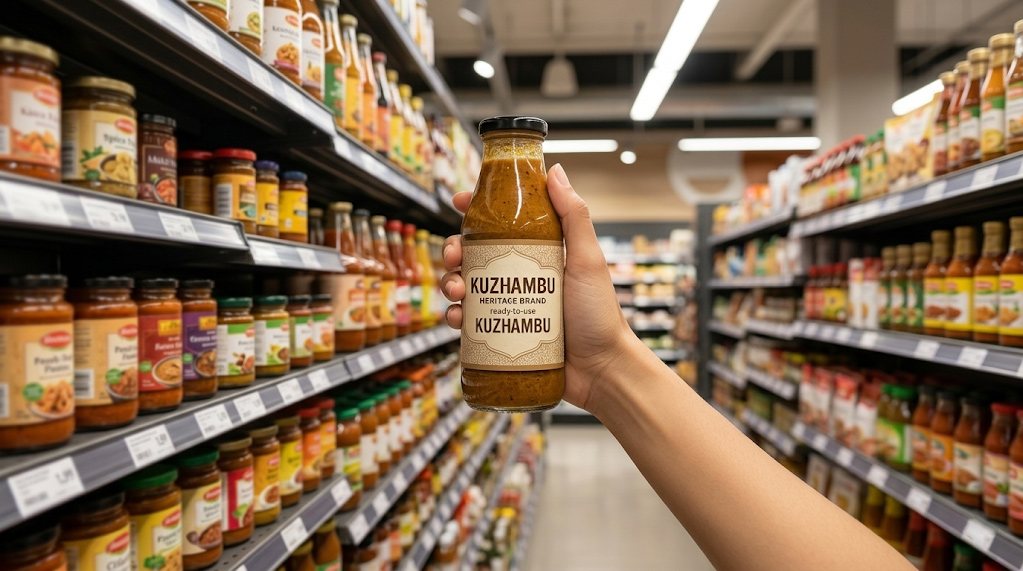
In Western retail, discovery is driven by familiarity and trust. The average shopper at Tesco or Costco spends less than three seconds looking at a shelf before making a decision. If they cannot immediately categorize your product within their existing lifestyle, they will not buy it.
Western customer perception is often hindered by three factors:
- Complexity: If the name is hard to pronounce or the usage is unclear, the friction is too high.
- Aesthetic Mismatch: Packaging that looks “traditional” to a diaspora founder may look “dated” or “unsafe” to a mainstream shopper.
- The Context Gap: Selling a traditional lentil snack as a “savory tea-time treat” fails because the Western shopper does not have a formal “tea-time.” Selling it as a “high-protein plant-based crisp” places it directly into their existing snacking habits.
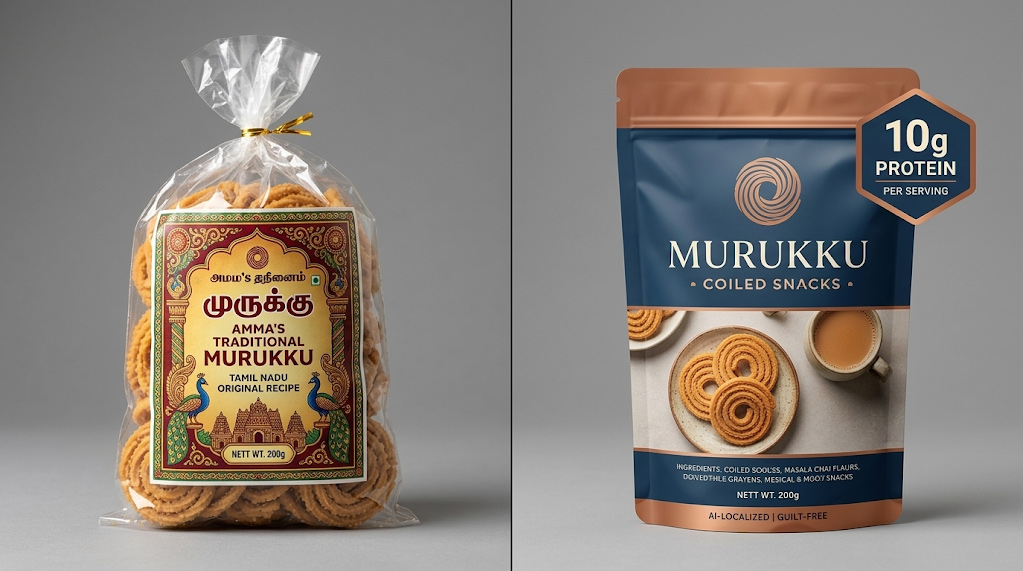
Comparison: Traditional vs. Mainstream Positioning
| Feature | Non-Localized Heritage Brand | Localized Mainstream Scaling Brand |
| Category | Ethnic Food | Premium Wellness / Functional Snack |
| Primary Hook | Authentic Heritage | High Protein / Clean Label / Low Sugar |
| Packaging | Vibrant, busy, traditional motifs | Minimalist, benefit-forward, modern |
| Retail Goal | Specialty International Grocery | Mainstream grocery stores (Target, Waitrose) |
| Consumer Perception | Occasional/Niche | Daily Staple / Healthy Alternative |
What is the difference between brand localization and product localization?
Scaling requires two distinct types of translation: brand localization and product localization.
Brand Localization (The “Why”)
This is about translating your values. Brand localization adapts your storytelling to fit the emotional triggers of a Western audience. While the diaspora buys your product for nostalgia, the mainstream consumer buys for a functional or lifestyle benefit.
“Scaling a heritage brand is not about erasing your roots. It is about building a bridge. You are not changing the soul of the product; you are changing the language of the packaging to ensure the Western shopper feels invited into the story rather than like an outsider looking in.”
— Founder of Vilampara Media
Product Localization (The “How”)
Product localization involves physical changes to meet market standards. This includes:
- Compliance: Meeting FDA, CFIA, or EFSA regulations.
- Sizing: Transitioning from bulk bags to single-serve or family-pack sizes common in mainstream grocery stores.
- Format: Turning a traditional “paste” into a “squeeze bottle” or a “ready-to-use sauce” to fit the Western demand for convenience.
The 4-Step Framework to Scale Heritage Products
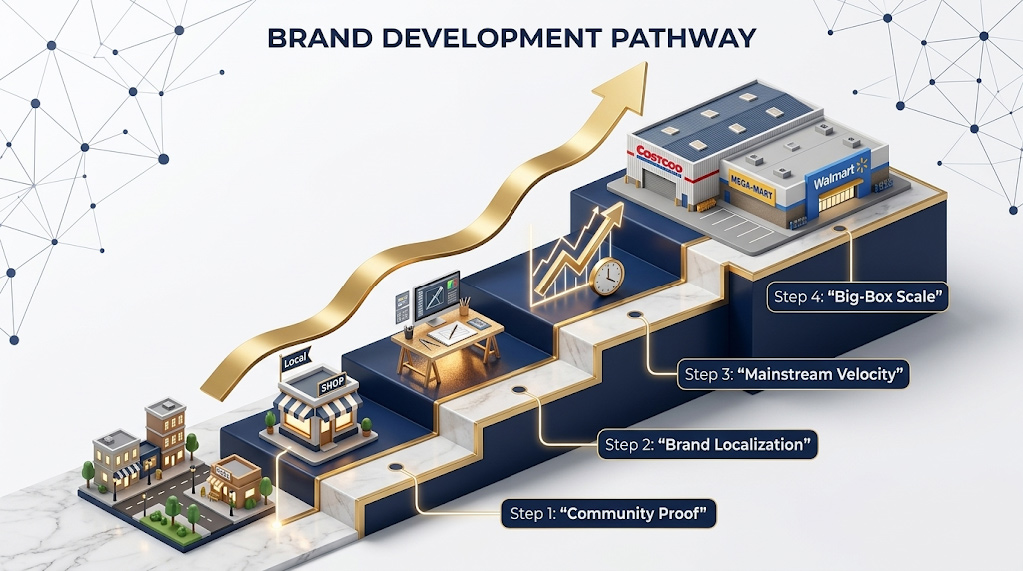
To move your brand into the mainstream, follow this operational sequence:
1. Audit Your Current Positioning
Use a Brand Positioning Map to plot your brand against mainstream leaders like Primal Kitchen or Kind Bars. If you are too far away from the “convenience” or “health” axes, you are stuck in the niche quadrant.
2. Solve the “Usage” Problem
The Western shopper asks: How do I use this tonight? If you sell a traditional spice blend, your brand positioning and strategy must show it being used on grilled salmon or avocado toast, not just in a traditional curry. This bridges the gap in Western customer perception.
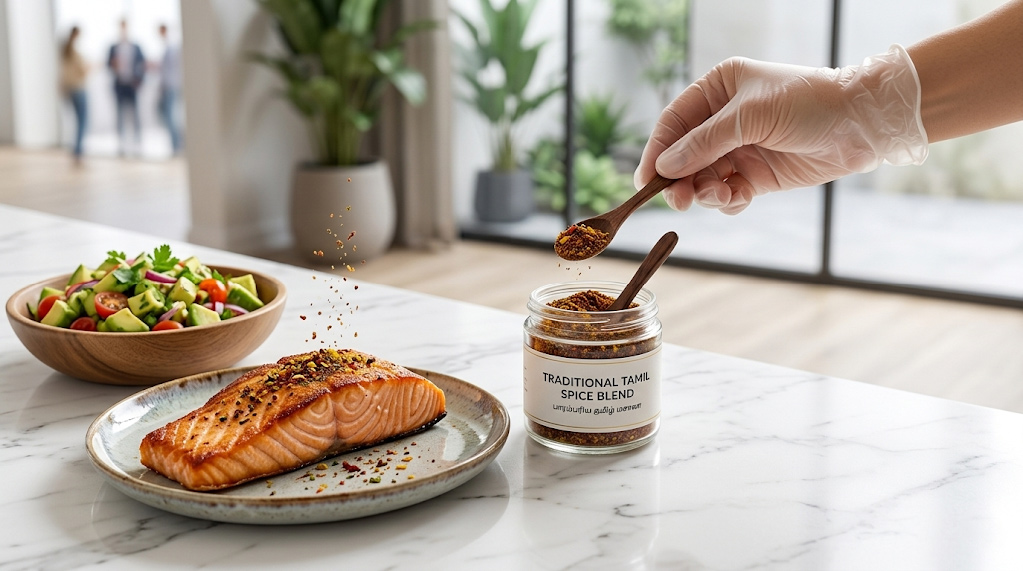
3. Simplify the Visual Language
Mainstream retail design is about “visual hierarchy.” Your packaging should communicate three things in this order:
- What is it? (e.g., Spicy Roasted Chickpeas)
- What is the main benefit? (e.g., 10g Protein)
- Why should I trust you? (e.g., Heritage recipe, Non-GMO)
4. Build Social Proof Beyond the Diaspora
Mainstream buyers at Walmart or Whole Foods look for “velocity data.” They want to see that non-Tamil consumers are buying your product. Use geofenced digital ads to drive traffic to specific mainstream grocery stores and collect data on customer demographics.
Real-World Comparison: Tamil Snacks vs. Protein Bars
Consider the traditional Murukku or Sev. For decades, these have been sold in large, unbranded bags in international aisles.
Compare this to the rise of “Ancient Grain Puffs.” They are essentially the same product. However, the “Puffs” are sold in 1.5oz bags with “Gluten-Free,” “Vegan,” and “Ancient Grains” prominently displayed. One stays in the specialty corner; the other scales to every Amazon Go and Starbucks in the country. The difference is the Brand Positioning Map.
Similarly, traditional spice blends like Turmeric or Ashwagandha were ignored until they were rebranded as “Golden Milk” or “Adaptogenic Supplements.” They moved from the “Spice” aisle to the “Wellness” aisle, where margins are 3x higher and Western customer perception is centered on health optimization.
Mastering the Brand Positioning Map
The path from a community favorite to a global contender requires a clinical approach to brand positioning and strategy. By understanding the Western customer perception and utilizing a Brand Positioning Map, you can identify exactly where your heritage product provides a solution that mainstream brands cannot match.
Scaling is a journey of translation. You must ensure that your product localization meets the functional needs of the busy Western shopper while your brand localization invites them into a story of quality and tradition.
If you are a diaspora founder ready to stop competing on price in the ethnic aisle and start competing on value in mainstream grocery stores, you need a partner who understands both your heritage and the mechanics of Western retail.
Vilampara Media specializes in bridging this gap. We help ambitious heritage brands build the demand-side infrastructure, digital presence, and positioning required to scale globally.
Actionable Insight: Look at your top-selling product today. If you removed the “culture” from the label, what functional problem does it solve? That is your starting point for the mainstream market. Localization is not changing your identity. It’s translating your value for a larger market.
Ready to re-position? Book a Strategy Call with Vilampara Media to audit your Brand Positioning Map today.
FAQ: Scaling Heritage Brands in 2026
- How do I get my product into Whole Foods or Costco?
You must prove “Mainstream Velocity.” Buyers need to see that your product sells to a wide demographic. Start with high-end independent grocers or Amazon to build a data set that proves your product localization is working.
- Is localization the same as “watering down” my culture?
No. Localization is not changing your identity. It’s translating your value for a larger market. It is about making your culture accessible, not invisible.
- Why is packaging more important than taste in the first 90 days?
Because a customer will not taste your product if they do not first trust the packaging. Western customer perception is built on the shelf. Taste creates repeat customers, but branding creates the first-time buyer.
- What are the most common mistakes diaspora founders make?
The most common mistake is assuming that “Authenticity” is a sufficient sales pitch. People don’t buy heritage alone. They buy familiarity, trust, and relevance.